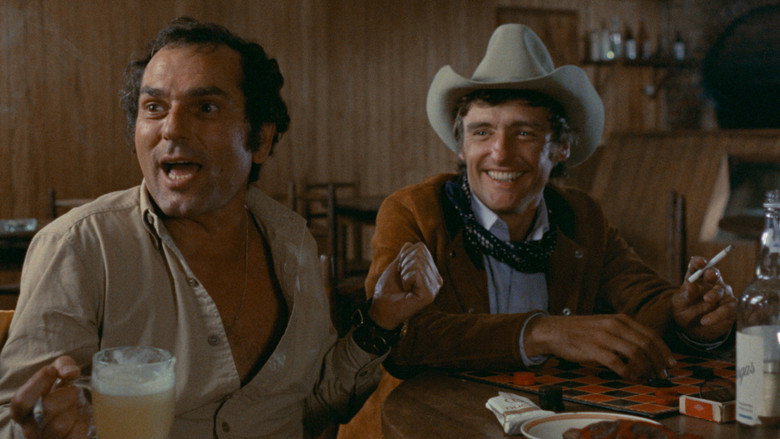

 6.1


Where can I stream The Last Movie?
In the United States, The Last Movie streams on Night Flight+, and it is free with ads on The Roku, Kanopy, Plex, and Fawesome. You can rent or buy it from Apple TV Store. It also streams in 7 other countries.
A slow-burning, ambiguous drama movie about show business and society.
Good for friends night · teens · thought-provoking
Skip it if you want fast pacing
Not for warmth, comfort or scares.
There is a time to die and a time not to
24 of 25
 Dennis HopperKansas
 Stella GarciaMaria
 Don GordonNeville
 Julie AdamsMrs. Anderson
 Roy EngelHarry Anderson
 Tomas MilianPriest
 Daniel AdesThomas Mercado
 Toni BasilRose
 Peter FondaYoung Sheriff
 Henry JaglomMinister's Son
 Kris KristoffersonMinstrel Wrangler
 Michelle PhillipsBanker's Daughter
 Dean StockwellBilly the Kid
 Russ TamblynMember of Billy's gang
 Samuel FullerSam
 John Phillip LawLittle Brother
 Sylvia MilesScript Clerk
 James MitchumArt
 John AldermanJonathan
 Rod CameronPat Garrett
 Severn DardenMayor
 Eddy DonnoStuntman
 Warren FinnertyBanker
Pick a department, or search for a name or a job (“editor”, “stunt”).
 You are here: The Last Movie
Point to compare, tap or drag to moveHold to compare, tap or drag to move
You are herePreview
vscompared with The Last Movie
The Last Movie1971
Point at a poster to compare itHold a poster to compare it
A chip fills to its level. Tap a full one for titles without that trait, a low one for titles with it.
Open a page:TÁR (2022)Stardust Memories (1980)Birdman or (The Unexpected Virtue of Ignorance) (2014)Opening Night (1977)The Five Obstructions (2003)Lost in La Mancha (2002)Jay Kelly (2025)Bergman Island (2021)Venus in Fur (2013)La Belle Noiseuse (1991)Close-Up (1990)Clouds of Sils Maria (2014)8½ (1963)Irma Vep (1996)Synecdoche, New York (2008)Drive My Car (2021)Adaptation. (2002)20,000 Days on Earth (2014)Through the Olive Trees (1994)Atlanta (2016)The Passenger (1975)Hearts of Darkness: A Filmmaker's Apocalypse (1991)Rosencrantz & Guildenstern Are Dead (1991)My Best Fiend (1999)The Square (2017)Being John Malkovich (1999)Official Competition (2021)La Dolce Vita (1960)Late Fame (2026)High Art (1998)I May Destroy You (2020)Blow-Up (1966)The Truman Show (1998)Code Unknown (2000)Sex and Lucía (2001)The Idiots (1998)Jigarthanda (2014)Youth (2015)Bitter Christmas (2026)Cold Souls (2009)Kidding (2018)The Christophers (2026)The Bad and the Beautiful (1952)Caro diario (1993)May December (2023)Broken Embraces (2009)The Great Beauty (2013)All That Jazz (1979)Blind (2014)Living in Oblivion (1995)Maelström (2000)A Different Man (2024)Nashville (1975)Beau Travail (2000)Phi (2017)I Want Your Sex (2026)The Morning Show (2019)Exit Through the Gift Shop (2010)Kevin Can F**K Himself (2021)The Trial (1962)The French Lieutenant's Woman (1981)The Congress (2013)Reprise (2006)Persona (1966)
 GoodWatch score 84
 GoodWatch score 83
 GoodWatch score 89
 GoodWatch score 80
 GoodWatch score 83
 GoodWatch score 79
 GoodWatch score 86
 GoodWatch score 62
September 29, 1971 · 1 h 48 min · R
Cargo Cult, Hooker with a Heart of Gold, The Last Title +1
From TV Tropes.
4 questions, like "Where can I stream The Last Movie?"
Quick answers from GoodWatch data.
In the United States, The Last Movie streams on Night Flight+, and it is free with ads on The Roku, Kanopy, Plex, and Fawesome. You can rent or buy it from Apple TV Store. It also streams in 7 other countries.
Opinions are mixed, with a GoodWatch score of 51 (IMDb 6.1 and Rotten Tomatoes 47%).
No, it needs your attention: the title analysis rates it 9 of 10 for meta narrative and 8 for philosophical.
Mostly character-driven: it leans on character depth (7 of 10) and dialogue centrality (6 of 10) more than on its plot.