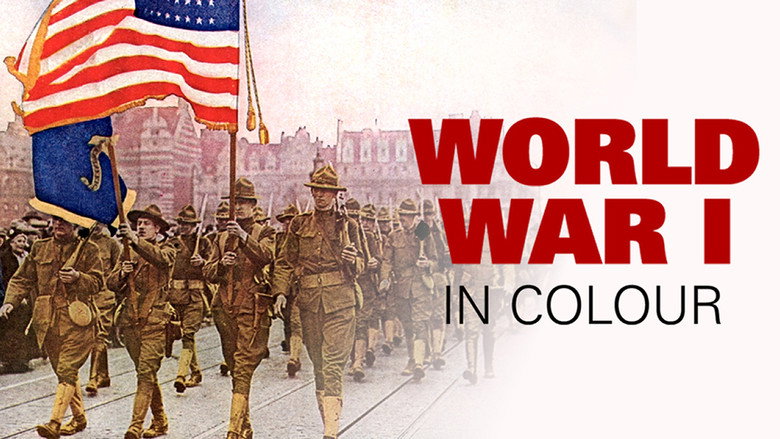
 8.1


Where can I stream World War I in Colour?
It streams in 2 other countries, but not in the United States.
A deeply moving, relentlessly bleak documentary series about history and war.
Good for friends night · binge-friendly · thought-provoking
Skip it if you want something to laugh at · you need an uplifting mood
Not streaming in United States. Where it is:
Not for warmth, uplift or laughs.
1 season · 6 episodes · best: S1E1 "Catastrophe" 7.8
Pick a department, or search for a name or a job (“editor”, “stunt”).
 You are here: World War I in Colour
Point to compare, tap or drag to moveHold to compare, tap or drag to move
You are herePreview
vscompared with World War I in Colour
World War I in Colour2003 · Show
Point at a poster to compare itHold a poster to compare it
A chip fills to its level. Tap a full one for titles without that trait, a low one for titles with it.
Open a page:The Civil War (1990)Greatest Events of World War II in Colour (2019)The World at War (1973)They Shall Not Grow Old (2018)Paths of Glory (1957)Das Boot (1981)Lebanon (2009)The Killing Fields (1984)Letters from Iwo Jima (2006)The Human Condition I: No Greater Love (1959)Stalingrad (1993)Kursk (2018)Shooting Dogs (2006)Das Boot (1985)Unknown Soldier (2017)Downfall (2004)Land and Freedom (1995)Days of Glory (2006)Oliver Stone's Untold History of the United States (2012)The Mission (1986)Border (1997)All Quiet on the Western Front (2022)The Forgotten Battle (2021)Far from Men (2015)Gallipoli (1981)Mangal Pandey - The Rising (2005)Captain Miller (2024)All Quiet on the Western Front (1979)All Quiet on the Western Front (1930)Gettysburg (1993)Fort Apache (1948)Tora! Tora! Tora! (1970)The Hill (1965)The Big Red One (1980)Kagemusha (1980)Tae Guk Gi: The Brotherhood of War (2004)Land of Mine (2015)Katyn (2007)I Am Cuba (1964)Hostiles (2017)The Battleship Island (2017)The Siege of Jadotville (2016)City of Life and Death (2009)The Warrior (2001)Tangerines (2013)The Longest Day (1962)The Way Back (2010)Empire of the Sun (1987)Barbarians (2020)The Wind That Shakes the Barley (2006)Spartacus (1960)The Boy in the Striped Pyjamas (2008)Dara of Jasenovac (2020)Beneath Hill 60 (2010)Valkyrie (2008)Bloody Sunday (2002)13 Assassins (2010)Hotel Rwanda (2004)The Uprising (2026)Ivan's Childhood (1962)The Shadow in My Eye (2021)Apocalypse: The Second World War (2009)A Bridge Too Far (1977)Farha (2021)
 GoodWatch score 94
 GoodWatch score 91
 GoodWatch score 93
 GoodWatch score 85
 GoodWatch score 80
 GoodWatch score 53
 GoodWatch score 71
 GoodWatch score 85
September 1, 2003 · October 6, 2003 · Ended
5 questions, like "Where can I stream World War I in Colour?"
Quick answers from GoodWatch data.
It streams in 2 other countries, but not in the United States.
Mostly, it's well received, with a GoodWatch score of 73 (IMDb 8.1).
5 h
About 5 hours: 6 episodes in 1 season of about 50 minutes each, aired from 2003 to 2003.
Probably not: the title analysis rates it 9 of 10 for bleakness and 8 for melancholy, against 1 for hopefulness.
Mostly character-driven: it leans on pathos (9 of 10) and dialogue centrality (7 of 10) more than on its plot.